Why
We Choose a Name Ohrid
Academic Journal
?
Ohrid
as Inspiration!
The choice of Ohrid as the
name of this journal is not merely an act of geographical homage; it
is a profound acknowledgment of a heritage that embodies the timeless
ideals of knowledge, creativity, and openness. Ohrid’s story—woven from myth, scholarship, art, politics, and
literature—offers a luminous inspiration for the academic mission
we pursue today.
A
Crossroads of Civilizations!
At the crossroads of
civilizations, Ohrid has long stood as a meeting ground of cultures
and ideas. Its legacy unites mythic imagination with
philosophical inquiry, while its continuity across centuries
reflects the resilience of human creativity. Legends such as that of
Cadmus remind us that Ohrid is not merely a place, but a symbolic
landscape where myth and history converge into enduring
meaning.
A
School of Learning!
In the ninth century, Saint
Clement of Ohrid established what is often regarded as the first
Slavic university or literary school. Thousands of students were
educated there, manuscripts were copied and created, and literacy
spread among Slavic peoples. This formative work shaped Slavic
written culture and contributed decisively to the development of the
Cyrillic tradition. The mission of preserving wisdom and
cultivating future generations resonates deeply with the
aims of modern academic institutions.
A
Fountain of Creativity!
Ohrid’s contribution
extended beyond education into the realm of artistic innovation. The
frescoes of the Church of St. Mary Perivleptos, revolutionary in
their time, introduced naturalism, emotional depth, and spatial
awareness that anticipated Renaissance tendencies centuries before
they blossomed in Western Europe. Ohrid thus stands as a place where artistic transformation occurred precociously, marking it as a fountain of enduring creativity.
A
Center of Faith and Dialogue!
The city’s significance
also encompassed politics and religion. Associated with the empire of
Tsar Samuil, Ohrid functioned as a major religious and political
center, shaping regional developments for generations. Archaeological
discoveries reveal its connections with the wider ancient world,
including remains dedicated to the Egyptian goddess Isis,
underscoring its role as a hub of spiritual and cultural
exchange. This diversity of traditions aligns with modern
academia’s emphasis on dialogue, plurality, and openness.
An
Intellectual Legacy!
Ohrid’s vitality did not
fade with the medieval period. Figures such as Grigor Prlichev,
celebrated as the “Second Homer,” bridged classical inspiration
with national awakening, demonstrating how Ohrid’s literary
tradition continued to shape cultural identity and creative thought.
Beyond such prominent examples, countless scholars, clerics, artists,
and thinkers contributed to the preservation and advancement
of learning, ensuring that Ohrid’s influence endures
across generations.
Guardians
of Knowledge!
Monasteries and churches,
functioning as centers of manuscript production and education,
safeguarded knowledge through times of upheaval. This tradition of
resilience mirrors the mission of academic publishing today: to
preserve and disseminate knowledge for future generations. In this sense, the Ohrid Academic Journal continues a legacy
of guardianship and intellectual stewardship
The
Natural Inspiration of Ohrid!
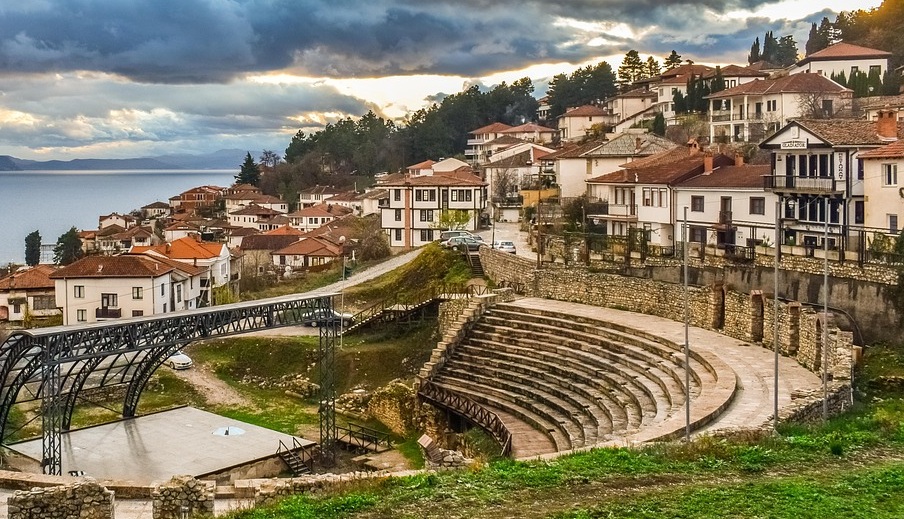
The natural beauty of
Ohrid, situated beside the ancient and crystal-clear Lake Ohrid—one
of Europe’s oldest lakes—adds another dimension to its
inspiration. Its landscapes have stirred poets, scholars, and
travelers for centuries, encouraging contemplation and
reflection—qualities essential to academic work. The
harmony between nature and culture found here serves as a metaphor
for balanced intellectual development.
A
Tradition that Transcends Borders!
Naming the journal after
Ohrid therefore connects this publication with a tradition that
transcends time and borders. It honors a place where education,
culture, and innovation have flourished for centuries, and
signals our intention to create a platform where scholarly
contributions from diverse disciplines and regions can meet,
interact, and grow—just as cultures and ideas have met and
interacted in Ohrid throughout history.
The
Mission of the Journal!
The Ohrid Academic
Journal seeks to continue this legacy in a modern context. It
aims to promote rigorous scholarship, encourage dialogue
across academic fields, and provide a space for both emerging and
established researchers alike. Just as Ohrid historically
served as a beacon of learning and cultural exchange, the journal
aspires to be a contemporary forum for intellectual collaboration,
carrying forward a tradition of openness, creativity, and shared
discovery.
Carrying
Ohrid’s Legacy Forward!
By carrying Ohrid’s name,
the journal acknowledges this remarkable heritage while contributing
to the global academic community. Through the Ohrid Academic
Journal, we aim to honor the past, engage with the
present, and inspire the future—continuing the long
tradition of learning that has made Ohrid a symbol of intellectual
and cultural richness for centuries.